This diagram illustrates the five operating states of an electric power system, which classify system conditions according to the balance between generation and load and compliance with System Operating Limits (SOLs). Puerto Rico’s electric power system is currently operating continuously in the Alert State because it lacks an adequate online generation reserve margin.
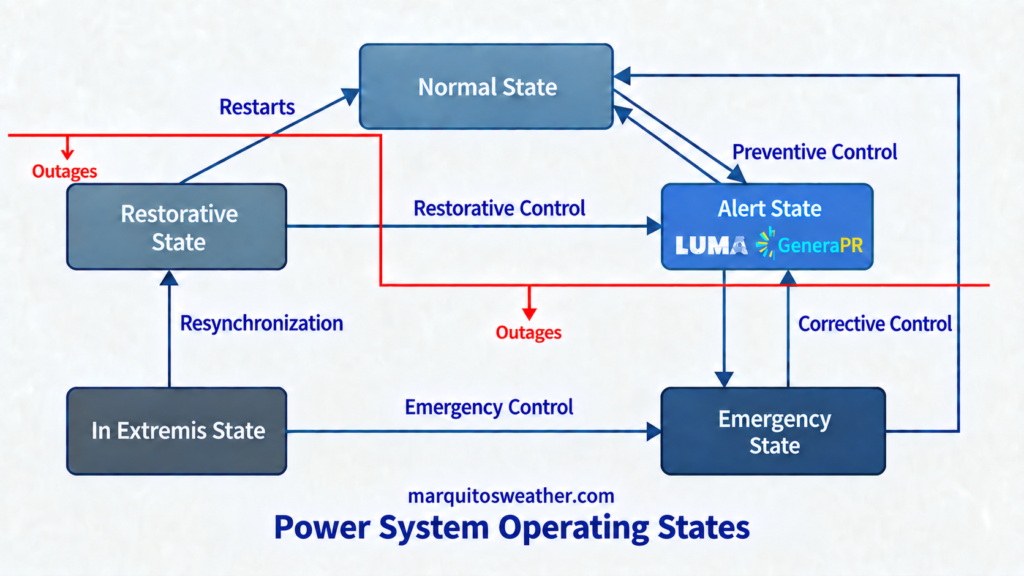
The following explains how the system transitions between states and the control actions performed in each state:
1. Normal State
- Condition: Generation and load are balanced, all System Operating Limits are satisfied, and an adequate security margin exists. The system is secure and operating normally.
- Transition: If a disturbance reduces the system’s security margin, it transitions to the Alert State.
2. Alert State
- Condition: Generation and load remain balanced, and System Operating Limits are still satisfied, but the security margin has been reduced. The system is vulnerable to an initial contingency. Puerto Rico is in this state because it lacks sufficient online operating reserves. A single contingency, such as the trip of a generating unit, can immediately push the system into the Emergency State.
- Control action: Preventive control actions—such as generation redispatch or topology changes, including opening or closing circuit breakers—are taken to return the system to the Normal State.
- Transition: If a severe disturbance occurs before preventive control actions become effective, the system transitions to the Emergency State.
3. Emergency State
- Condition: Generation-load balance and/or System Operating Limits are violated—for example, due to overloaded transmission lines, low voltage, or low frequency—but the system remains intact as a single interconnected entity.
- Control actions:
- Corrective control is applied in an attempt to return the system to the Alert State.
- Emergency control actions, such as Underfrequency Load Shedding (UFLS) or Rotating/Selective Load Shedding, are implemented to prevent a total system collapse.
- Transition: If these actions fail, the system deteriorates into the In Extremis State.
4. In Extremis State
- Condition: The system has begun experiencing cascading outages or separating into electrically isolated islands. Both generation-load balance and System Operating Limits are violated.
- Control actions: Emergency measures—such as controlled system separation, large-scale load shedding, or preparation for black-start operations—are deployed to preserve as much of the power system as possible.
- Transition: Once the cascading collapse has been arrested, the stabilized but fragmented portions of the system enter the Restorative State through resynchronization.
5. Restorative State
- Condition: System operators are actively reconnecting separated portions of the power system and restoring interrupted loads.
- Control actions:
- Restorative control seeks to gradually reconnect transmission lines and restore load, which may temporarily move the system into the Alert State.
- System restarts return the fully reconnected system directly to the Normal State.